Video has firmly established itself as the dominant medium of modern communication. From short-form social media clips on TikTok and Instagram Reels to detailed tutorials on YouTube and high-production corporate media, video content consistently yields higher engagement, better retention, and superior conversion rates compared to static text or images. However, despite its undisputed effectiveness, video production has historically presented a high barrier to entry. Creating compelling video content traditionally required specialized software skills, hours spent manually sifting through raw footage, tedious timeline assembly, precise audio alignment, and painstaking text-caption generation.
The rise of generative Artificial Intelligence (AI) is rapidly altering this landscape. Over the past few years, machine learning algorithms have evolved from basic automated filters into sophisticated creative partners capable of generating realistic visuals, composing audio tracks, and synthesizing natural voiceovers. Among these breakthroughs, one of the most significant developments is the integration of Large Language Models (LLMs) like ChatGPT into the core video creation workflow.
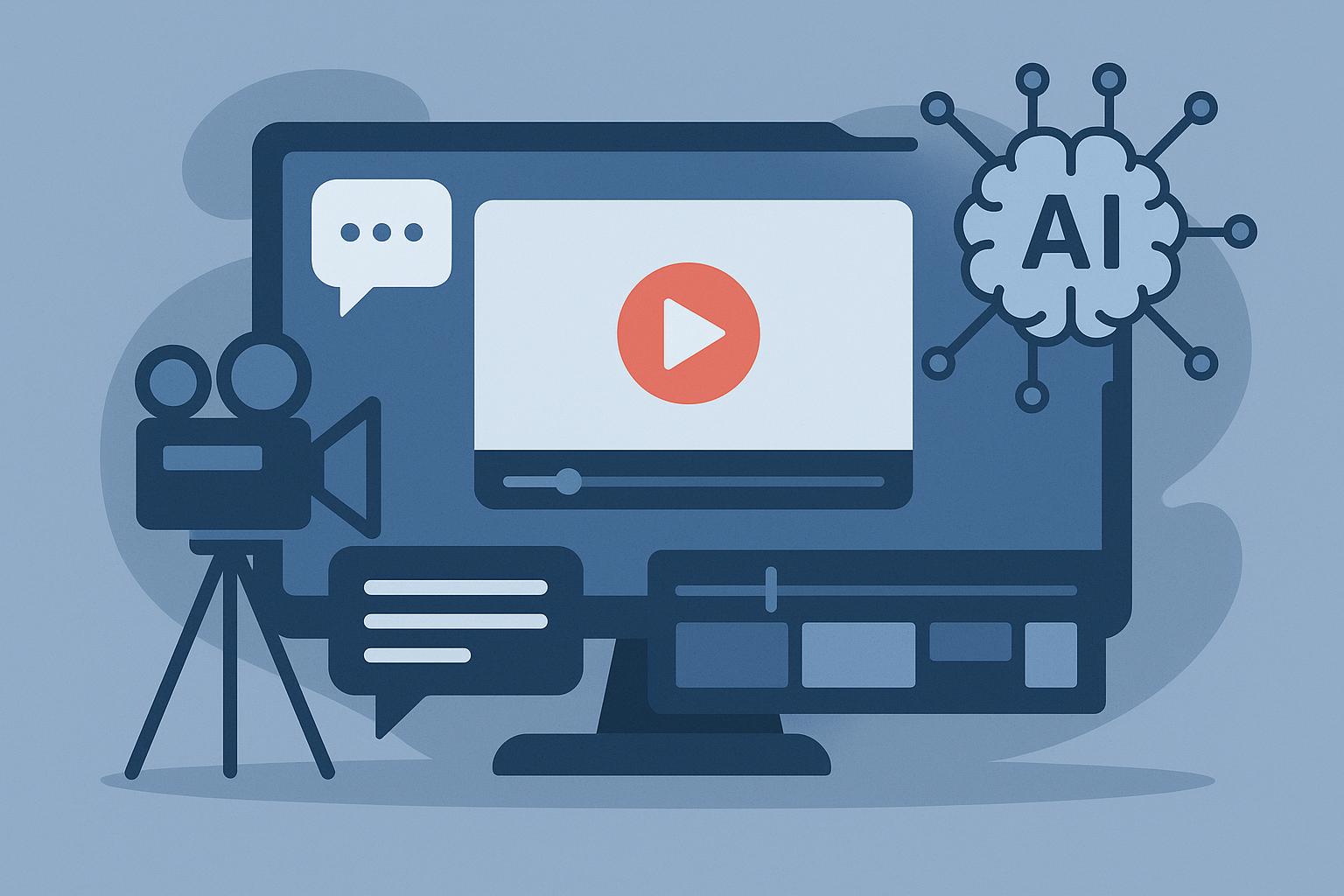
By bridging natural language processing with timeline-based visual editing, creators can now produce full video drafts simply by describing their vision in plain text. This article explores how conversational AI is revolutionizing digital video production, why natural language interfaces represent the next major evolution in creative software, and how modern workflows enable creators to move from ideation to final cut faster than ever before.
Understanding Natural Language Interfaces in Video Editing
Historically, video editing applications relied on complex Graphical User Interfaces (GUIs) featuring stacked tracks, nested sequences, parametric audio equalizers, keyframe graphs, and color wheels. While these interfaces offer incredible precision for seasoned post-production professionals, they present a steep learning curve for general creators, marketers, educators, and small business owners.
The introduction of LLM-powered creative workflows changes the fundamental interaction model from point-and-click manipulation to intent-based conversation. Instead of manually cutting clips, inserting transition nodes, and searching stock databases, users can prompt an AI assistant using everyday language.
How Text Prompts Translate to Video Timelines
At a technical level, an AI system processing a natural language video request operates through several key stages:
- Intent Extraction and Script Generation: The underlying language model analyzes the user’s prompt to understand the requested tone, structure, target audience, and main message. It generates a full narrative script alongside visual direction notes.
- Asset Retrieval and Scene Mapping: The system analyzes the generated script and automatically pulls relevant visual assets—whether stock footage, AI-generated images, or user-uploaded media clips—matching the narrative requirements of each segment.
- Sequence Assembly: Rather than returning a static, unchangeable render, modern integrations map these assets directly onto a non-destructive multi-track video timeline. This includes aligning audio tracks, placing background music, and generating synchronized subtitle tracks.
- Refinement and Iteration: Users can provide follow-up text commands to modify the draft—such as “make the intro faster,” “change the tone to energetic,” or “swap out the background music”—allowing for real-time iterative editing.
This approach combines the intuitive ease of chatting with a virtual assistant with the structural flexibility of desktop-grade editing applications.
Streamlining the Creative Pipeline: From Script to Draft
The integration of conversational AI into video tools addresses one of the biggest bottlenecks in modern content operations: the gap between ideation and initial draft. The standard video production pipeline traditionally follows a linear process—ideation, scriptwriting, storyboard planning, footage gathering, rough cutting, fine editing, captioning, and final rendering. An AI-assisted workflow condenses the first five steps into a single, cohesive action.
1. Rapid Ideation and Concept Validation
Creators no longer need to face the anxiety of a blank timeline. By describing a general topic—for example, “Create a 60-second instructional video on healthy meal preparation for busy professionals”—the AI generates multiple thematic approaches, suggested visual styles, and narrative arcs within seconds.
2. Automated Asset Assembly and Timeline Building
Finding the right B-roll footage and pairing it with suitable audio usually accounts for a massive portion of editing time. Modern video editing extensions and plugins automatically select appropriate visual overlays and construct a coherent timeline structure. Using an intuitive AI video editor with ChatGPT allows creators to feed text scripts directly into an editing workspace, instantly yielding editable timeline drafts complete with flexible audio tracks, visuals, and dynamic captions.
3. Automated Subtitles and Dynamic Typography
With a significant percentage of online video consumed on mute, accurate captions are non-negotiable. Modern AI systems handle speech-to-text processing with exceptional precision, auto-generating captions, formatting timing data, and applying visually appealing text animations that keep viewers engaged on social feeds.
Key Benefits of AI-Driven Video Editing
The shift toward AI-enhanced video production delivers tangible benefits across various creative and commercial domains:
| Benefit | Description | Primary Impact |
|---|---|---|
| Speed & Efficiency | Reduces draft turnaround times from hours to minutes. | High-volume social media teams, news outlets |
| Accessibility | Eliminates the need for years of technical editing training. | Educators, solo founders, content marketers |
| Consistency | Applies brand guidelines, color palettes, and typography rules automatically across campaigns. | Marketing agencies, enterprise brand managers |
| Iterative Freedom | Enables rapid testing of multiple hooks, visual styles, and lengths without rebuilding projects from scratch. | Performance marketers, A/B testing campaigns |
Best Practices for Prompting AI Video Tools
While AI handles the heavy lifting of timeline construction and asset organization, the quality of the final video relies heavily on the clarity and specificity of the user’s initial instructions. Prompting an AI video editor effectively requires a balance of narrative direction and structural parameters.
- Define the Goal and Audience: Explicitly state who the video is for and what action they should take. (e.g., “Targeting entry-level developers, create an encouraging 30-second summary of key Git commands.”)
- Specify Tone and Visual Style: Indicate whether the visual output should feel professional, playful, cinematic, minimalist, or fast-paced.
- Provide Aspect Ratio and Length Constraints: Clearly state the intended platform (e.g., 9:16 vertical for TikTok/Reels vs. 16:9 horizontal for YouTube/Web) so the AI selects and crops media assets accurately.
- Leverage Hybrid Editing: Treat the AI output as a powerful first draft rather than a unchangeable final product. Use automated assembly to handle 80% of the mechanical work, then step in manually to fine-tune pacing, trim clip boundaries, and add personal creative touches.
The Human-in-the-Loop Advantage
Despite rapid advancements in artificial intelligence, AI is not a replacement for human artistic intent, emotional resonance, and strategic vision. The most effective content operations view AI tools as force multipliers rather than autonomous authors.
An AI model can instantly arrange footage to match a voiceover, apply transitions, and format subtitles. However, nuanced storytelling—knowing exactly when to pause for emphasis, selecting a frame that evokes a specific emotion, or ensuring subtle brand humor hits correctly—remains fundamentally human. The emerging standard in video creation is a hybrid framework: AI handles structural generation, and human creators guide narrative vision.
Conclusion
The convergence of natural language processing and video production tools marks a major milestone in digital media. By enabling creators to interact with editing software through conversational AI, the friction between concept and execution has decreased significantly. Complex video assembly tasks that once required dedicated technical training can now be initiated through simple text prompts.
As these tools continue to mature, the focus of content creation will shift increasingly away from technical software execution and toward creative direction, strategic storytelling, and conceptual originality. For brands, creators, and educators alike, adopting AI-driven video workflows offers an unprecedented opportunity to produce richer visual stories at a scale and speed never before possible.