In today’s fast-paced digital ecosystem, visual content reigns supreme. Whether for digital marketing campaigns, personal branding, e-commerce storefronts, or multimedia storyboards, the demand for striking, high-quality graphics has accelerated beyond traditional production speeds. Historically, bringing a visual concept from ideation to realization required complex graphic design software, specialized illustration skills, or costly photoshoots.
However, the rapid maturation of generative artificial intelligence (GenAI) has democratized visual creation. Deep learning architectures—specifically latent diffusion models and multimodal transformers—have fundamentally altered how creators approach imagery. Today, non-technical creators and seasoned creative directors alike can turn textual prompts into intricate digital artwork, hyper-realistic photos, and conceptual layouts in a matter of seconds.
Understanding the underlying mechanics of modern AI image generation, its creative and commercial applications, and best practices for prompt engineering provides valuable insight into the future of digital visual media.
The Technology Behind Modern Text-to-Image Synthesis
To appreciate how generative AI converts simple language into visual assets, it is helpful to look under the hood of neural networks. Generative models operate through intricate mathematical frameworks that translate human language into pixel-level representations.
1. Latent Diffusion Models (LDMs)
Earlier generative frameworks relied heavily on Generative Adversarial Networks (GANs), which pitted a generator network against a discriminator network. While powerful, GANs often struggled with diversity and complex spatial prompts.
Modern image synthesis relies predominantly on Latent Diffusion Models. In a diffusion model:
- Forward Process: Gaussian noise is systematically added to a training dataset of images until the image transforms into pure mathematical noise.
- Reverse Process: The neural network learns to reverse this process, predicting and removing noise step-by-step to reconstruct a clear visual.
By operating in a compressed “latent space” rather than at pixel resolution, diffusion models dramatically reduce computational load while producing high-fidelity outputs rich in micro-details, textures, and realistic lighting.
2. Cross-Attention and Language Conditioning
Connecting natural language to visual elements requires text encoders, such as Contrastive Language-Image Pre-training (CLIP) or T5 transformers. These text encoders break down a user’s prompt into semantic embeddings—numerical vectors capturing concepts like “cyberpunk,” “golden hour,” or “minimalist ceramic vase.”
During the reverse diffusion process, cross-attention mechanisms align the visual noise reduction with these semantic embeddings, ensuring the synthesized pixels reflect the specific subjects, moods, and stylistic cues requested in the prompt.
Unlocking Multi-Format Workflows: Bridging Static and Motion Design
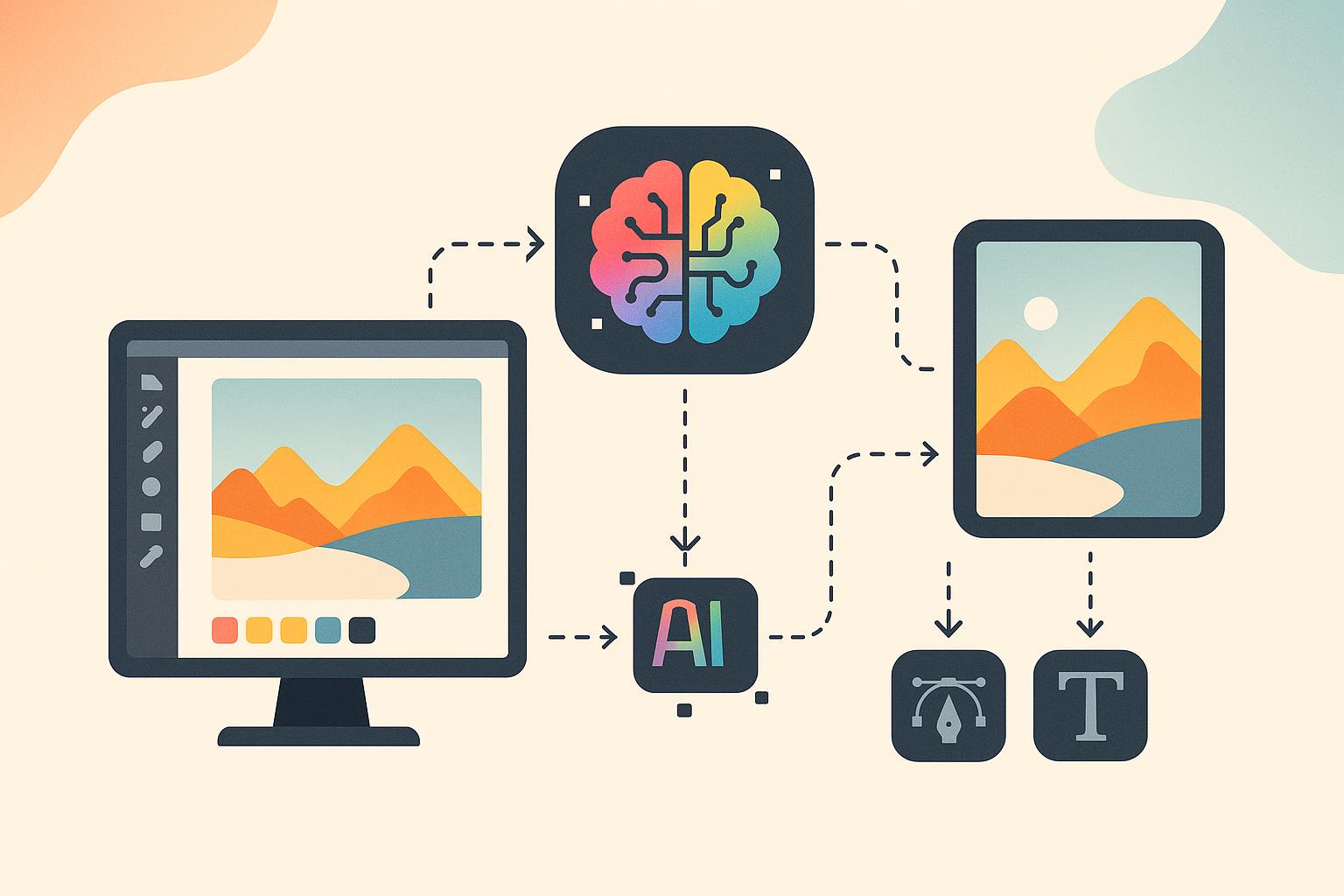
One of the most significant shifts in generative design is the transition from isolated static image generation to integrated visual workflows. Historically, generating an image using an isolated web app meant exporting the file, importing it into a third-party photo editor for touch-ups, and then transferring it to a video editing suite if animation was required.
Modern creative platforms eliminate this fragmentation by embedding generative engines directly alongside web-based post-processing suites. For instance, creators seeking an efficient content production setup often turn to a robust free AI image generator to produce high-resolution art, background elements, or brand assets within a single ecosystem.
Once a visual asset is synthesized, integrated tools enable instant refinements:
- Inpainting and Outpainting: Modifying localized sections of an image without regenerating the entire canvas, or expanding the aspect ratio from a 1:1 square to a 16:9 thumbnail format seamlessly.
- Image-to-Image Conditioning: Uploading a pose reference, sketch, or mood board image to guide the AI’s composition while applying a totally new visual style.
- Direct Image-to-Video Transformation: Converting static generative renders into dynamic visual stories by applying camera movement, motion keyframing, auto-generated voiceovers, or background music directly within the editor.
This unified approach allows solo entrepreneurs, digital marketers, and social media managers to maintain high visual consistency without jumping between multiple software subscriptions.
Practical Applications Across Digital Industries
Generative visual technology has moved far beyond novel experimentation; it is actively reweaving operations across multiple commercial sectors.
E-Commerce and Digital Retail
Photorealism in generative AI allows e-commerce brands to build lifestyle showcases quickly. Instead of booking studio space, hiring lighting technicians, and sourcing physical props for seasonal campaigns, merchandisers can place a product render onto an AI-generated scene featuring customized lighting, backdrops, and architectural aesthetics.
Digital Marketing and Social Media
In high-velocity social environments like Instagram, TikTok, and YouTube, content fatigue sets in quickly. Marketers use text-to-image engines to generate varied ad creatives for A/B testing. By tweaking prompt variables—such as lighting scheme, color palette, or background setting—teams can test dozens of visual angles to discover what resonates best with target demographics.
Concept Art and Storyboarding
In entertainment, game development, and film pre-production, speed is critical during initial ideation phases. Concept artists leverage generative AI to rapidly mock up world-building elements, environmental scenes, and character costume variations. This speeds up early creative discussions before committing full technical resources to 3D modeling or video production.
Crafting the Perfect Prompt: The Art of Prompt Engineering
To get precise results from AI generators, users must learn the craft of prompt engineering. Generative models interpret descriptive, structured language much better than vague keywords.
The Anatomy of an Effective Prompt
A high-performing prompt can be broken down into five distinct structural components:
- Core Subject: Clearly state the focal point (e.g., “A vintage mechanical wristwatch”).
- Environment/Context: Describe the surroundings (e.g., “resting on a dark polished mahogany desk next to an open fountain pen”).
- Lighting & Atmosphere: Specify the illumination quality (e.g., “dramatic side lighting, warm golden hour sunbeams filtering through window blinds”).
- Artistic or Technical Style: Define the rendering medium or camera lens (e.g., “macro photography, shot on 35mm lens, f/1.8 aperture, realistic texture, shallow depth of field”).
- Color Palette: Indicate key color tones (e.g., “deep amber, rich espresso, and muted brass accents”).
Example Transformation:
- Weak Prompt: “A cool futuristic car.”
- Optimized Prompt: “An aerodynamic electric concept car driving on a rain-slicked highway at twilight, vibrant neon cyan and magenta streetlights reflecting off the matte black bodywork, sleek cinematic photography style, motion blur on wheels, 8k resolution focus.”
Best Practices for Integrating AI Graphics into Design Workflows
While AI visual generators accelerate content creation, maintaining professional visual standards requires intentional execution.
- Maintain Brand Consistency: Develop a standardized prompt library for your brand. By re-using specific lighting descriptions, color hex codes, and medium style keywords across prompts, your generated assets will maintain a unified brand identity across platforms.
- Review Details Carefully: Inspect complex generated outputs for common algorithmic anomalies, such as distorted hands, mismatched background symmetry, or unnatural reflection angles. Utilize integrated localized editing or touch-up tools to fix minor flaws.
- Combine AI with Human Craft: Treat AI-generated images as high-grade foundational assets. Overlay custom typography, vector logos, brand watermarks, and tailored color grading to transform raw AI outputs into finished, brand-aligned visual assets.
The Future of Visual Creation
As foundational models continue to evolve, generative AI is moving toward greater spatial control, higher precision in rendering fine details, and real-time interactive generation. The integration of image synthesis with video production and 3D modeling tools signals a future where creative workflows are frictionless, intuitive, and bound only by human imagination.
By adopting generative tools as collaborative creative partners, designers, marketers, and content creators can significantly shorten the path from initial thought to finished design—unlocking unprecedented freedom in visual storytelling.